Tactical Tuesday
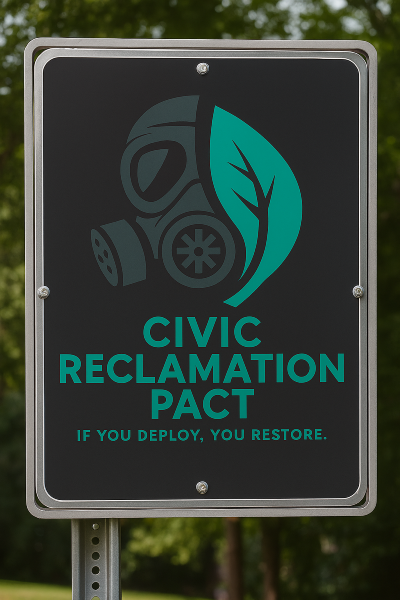
Forcing the feds to clean up their spent tear gas canisters and other irritants
Welcome to the inaugural "Tactical Tuesday" post. Rather than just offer commentary on what we see happening with regards to our spatial sovereignty and civic systems, the Urban Theater strives to offer concrete solutions to Mayors, City Councils, NGO's and other subnational actors trying to steady their ships in the light of federal retrenchment and hostility.
In Portland, residents complain of nightly tear gas attacks from ICE agents causing some to throw up and lose weight from the constant lingering of gas. In other communities like Chicago's Broadview neighborhood, it's as bad or worse. In every city ICE has conducted operations, they've left a toxic mess behind. So here's three strategies for City and County leaders:
1) You can ban the use of chemical irritants via City Code.
2) You can require ICE, et.al. to post a reclamation bond prior to conducting operations utilizing chemical irritants, guaranteeing the mitigation of toxins.
3) You can codify standards for the cleanup of toxic chemicals.
Banning Chemical Irritants
This potentially represents the easiest way to safeguard residents from hazardous chemicals. In 2021, Acting Mayor Kim Janey signed into law a ban on the use of chemical irritants in the City of Boston. You can also see the full presentation to Council here. Various other entities including Washington D.C., Portland, OR (only bans PPD from using various less-than-lethal and chemical irritants for crowd control), and Colorado also restrict the use of these in some way. As noted this may be the easiest way to reduce the use of irritants and less-than-lethal controls, however, Police Union contracts may stipulate that the department reserves the authority to deploy these tactics as deemed necessary. In that instance, obviously, this may not not be the most timely or efficacious option.
Require Federal Law Enforcement Agencies and their Contractors to Post a Reclamation Bond Guaranteeing Clean Up
If you polled 10,000 city budget officials, they'd be familiar with budgeting, financial accounting, reporting and auditing, ERP systems, debt management and the like. Poll those same 10,000 on the use of the Little Miller Act and you'd get over 9,500 blank stares. Those same budget officials maybe know that all public works contracts must be guaranteed by a Surety Bond, to insure the tax payers get what they've paid for. For example, if a school district lets a contract for a new High School, the contractor awarded the job must post a bond with the district insuring that it will 1) complete the project; and 2) use the awarded money to do so. In the event of failure, the bond guarantees completion of the project and thus the proper use of tax dollars. This is all spelled out in each state's version of the Little Miller Act. But that's not all that surety can guarantee.
Cities or States typically require surety on mining projects in the form of a "reclamation bond." If you look at a City map you'll note that most of the mining operations take place within city limits. Why? Because we need basic aggregates available close to where they are being used and that is in urban construction. So the point of the reclamation bond is that the mine operator must return the property to near to its original form once it's played out so that it can be used for another purpose. In Idaho, the Department of Lands administers reclamation policy under the Mined Land Reclamation Act. Guess what? That's not the only thing that you could feasibly utilize a reclamation bond for.
You could require that ICE/HSI, etc., and their contractors post a Reclamation Bond in the amount of $50,000 for each use of chemical irritants in the theater before actually deploying those irritants. This serves four purposes: 1) advance knowledge of the intended theater of operations; 2) a gumming up of the works; 3) places an additional substantial cost on federal operations; 4) guarantees the Federal Government complies.
And the legislative template looks something like this:
Legislative Language: Civic Reclamation Bond Ordinance
Title: Civic Reclamation Bond Requirement for Federal Tactical Deployments
Section 1: Purpose and Intent This ordinance establishes a mandatory reclamation bond requirement for any federal agency, contractor, or deputized entity conducting tactical operations within city limits involving chemical agents, crowd control ordnance, or military-style equipment. The intent is to ensure environmental remediation, civic restoration, and public accountability following such deployments.
Section 2: Definitions
- Tactical Operation: Any deployment involving tear gas, pepper spray, smoke canisters, rubber bullets, flashbangs, or other less-than-lethal ordnance.
- Federal Entity: Includes any agency of the United States government, its contractors, or deputized local entities acting under federal authority.
- Reclamation Bond: A financial surety instrument guaranteeing post-operation cleanup, restoration, and public reporting.
Section 3: Bond Requirement Prior to any tactical operation, the deploying entity must post a reclamation bond with the City Treasurer in an amount determined by the Civic Reclamation Valuation Rubric (see Section 5). No operation may proceed without bond certification.
Section 4: Scope of Reclamation Bond proceeds may be used for:
- Environmental cleanup of chemical agents and ordnance residue
- Restoration of public infrastructure and private property
- Air and water quality testing
- Public health mitigation
- Civic trust restoration (e.g., community hearings, trauma support)
Section 5: Valuation Rubric Bond amounts shall be calculated using the rubric defined by the Office of Civic Resilience (see below).
Section 6: Enforcement and Forfeiture Failure to complete reclamation within 30 days shall result in bond forfeiture. Funds will be administered by the Office of Civic Resilience for direct remediation and community support.
Section 7: Transparency and Reporting All tactical deployments and reclamation efforts shall be publicly reported within 15 days, including ordnance used, cleanup status, and community impact assessments.
Section 8: Severability If any provision of this ordinance is found invalid, the remainder shall remain in effect.
Notes on the deployment of this tactic - a market may not yet exist for this type of financial product. But where the need appears, the product will also. Secondly, states may preempt cities from using such a tactic. City Attorney's Offices in larger municipalities most likely have an attorney who can answer this question. Every city in the U.S. should have an attorney on staff knowledgeable of these matters.
Codify Standards for the Cleanup of Toxic Chemicals
This as simple as adding an ordinance requiring certified third-party clean up of any impacted site, and establishing a set of standards for contractors to follow.
Checklist is something to the effect:
This checklist is designed for third-party remediation crews tasked with restoring public or private sites after tactical operations involving:
- Tear gas (CS, CN, OC)
- Smoke grenades
- Flash bangs / stun devices
- Pepper spray residue
- Chemical foam or dye markers
Key Checklist Items
- Site Assessment
- Document affected zones (interior/exterior)
- Identify residue types and dispersal patterns
- Protective Equipment
- Respirators, gloves, Tyvek suits
- Decontamination protocols for crew
- Surface Remediation
- HEPA vacuuming of particulates
- Neutralizing agents for CS/CN compounds
- Pressure washing with containment barriers
- Air Quality Restoration
- Ventilation and filtration
- Air sampling for lingering irritants
- Waste Disposal
- Hazardous waste classification
- Chain-of-custody documentation
- Community Notification
- Post-cleanup signage
- Optional public health advisory
And what you'd include in an ordinance:
Draft Ordinance: Tactical Residue Remediation Protocol
This ordinance represents a public health and environmental justice measure, requiring cleanup after any deployment of chemical crowd control agents within city limits.
Key Provisions
- Triggering Events
- Any use of chemical irritants, smoke, or flash devices by law enforcement or federal agents
- Responsible Party
- The deploying agency or property owner must contract certified remediation within 24 hours
- Standards
- Cleanup must follow EPA and OSHA guidelines for hazardous chemical residue
- Enforcement
- Noncompliance results in fines, public health citations, and possible lien placement
- Transparency
- Public reporting of cleanup status and contractor certification
So that gives subnational actors three potential ways to reclaim their blocks, neighborhoods and cities, protect the health and safety of their residents, and reassert spatial authority in the face of federal retrenchment and hostility. Remember, this is a blog post not legal/consulting advice, but we're happy to engage on all these issues in whatever form helps our cities reclaim their space.